6G standardisation begins as operators seek AI-native networks

By Tony Poulos
Jun 3, 2026
To embed our video on your website copy and paste the code below:
<iframe src="https://www.youtube.com/embed/PNnvkq_nG8g?modestbranding=1&rel=0" width="970" height="546" frameborder="0" scrolling="auto" allowfullscreen></iframe>
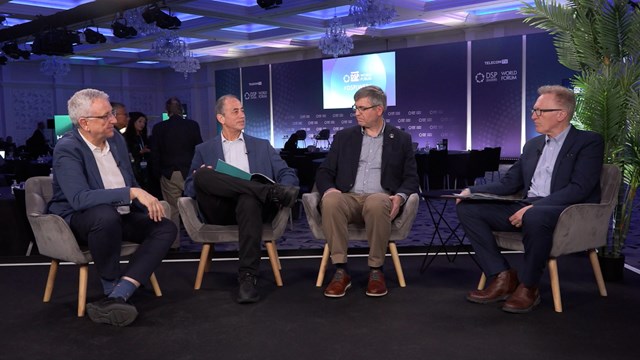
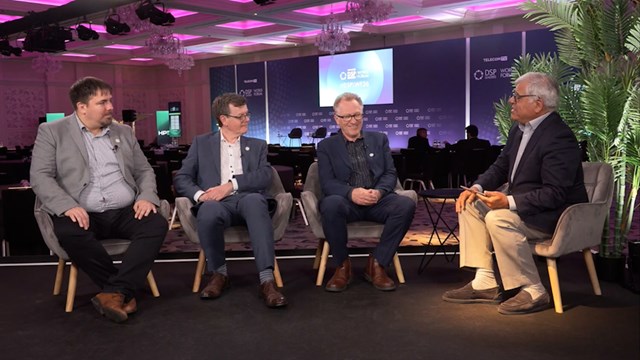
This is Extra Shot at the DSP Leaders World Forum in Windsor. I'm Tony Poulos and I'm here today with Anita Döhler, who is the Chief Executive Officer for the NGMN Alliance. Welcome, Anita. Next I have Mark Gilmour, who's the director and principal consultant at Marlis Consulting and next to you and last but certainly not least, Laura Armstrong-Bertolett, who is the senior transformation lead at BT. Thank you for coming. We've just had two fabulous sessions talking about AI native route to 6G and the cultural shift for telco transformation. Very heavy topics. We've only got a few minutes to talk about them, but I want to kick off with you, Anita. We keep hearing that MNOs have not maximised the return on their 5G investment. So is it too early to be talking about 6G?
Anita Döhler, NGMN Alliance (01:03):
Absolutely not too early, even though of course some people believe it is. The problem or the issue is that the standardisation always takes a long time and even though the landscape has changed with regards to open source and other areas, the standardisation already kicked off in 3GPP for instance. And therefore it's absolutely important that learning from the 5G experience as we start to influence it right now and as NGMN, we are providing the operator driven requirements and guidance to the industry with regards to 6G.
Tony Poulos, TelecomTV (01:39):
What are the main drivers behind the move to 6G? What are we trying to achieve with 6G?
Mark Gilmour, Marlis Consulting (01:44):
Well, right now is actually a really critical time because there's some inputs going into 3GPP that will essentially drive how the roadmap goes for operators to that. We heard a little bit about that on the first panel today. So right now is absolutely critical. It's critical timing right now for operators to be putting in that voice, for example.
Tony Poulos, TelecomTV (02:07):
Do you want to add to that, Laura?
Laura Armstrong-Bertolett, BT (02:09):
I think we are standing on the cusp of a major transformation as we look to deploy AI increasingly across areas of the organisation. And what I'd like to bring out is really that that impacts all areas of the organisation, because say I deploy an AI technology onto my network or into my particular programme, actually the life shelf of that technology is ever shorter, therefore I need to shorten my procurement, my legal processes, et cetera, et cetera. It just starts to spread throughout an entire organisation, the rapidity of the technology.
Tony Poulos, TelecomTV (02:41):
Well, Anita, we're going to come back to you. What role is AI going to play in 6G because they seem to be inextricably linked already?
Anita Döhler, NGMN Alliance (02:47):
Of course, AI doesn't need 6G. So it was mentioned in the first panel today very well that AI starts to be in place already today. So 5G needs to be already ready for or embracing AI. But when we design 6G, we need to consider that AI will change a lot of different areas and that the network... So our guidance is that the network design needs to be as flexible as possible to cover for things we cannot fully predict right now. So for instance, physical AI will change requirements with regards to traffic patterns most likely and the networks will need to be able to adjust to those changing situations.
Tony Poulos, TelecomTV (03:36):
So what is an AI native network? And we're talking about that of course in that session. We heard that 5G is not actually geared to be AI native and we're moving to 6G hoping that will be AI native. What's the truth behind that, Mark?
Mark Gilmour, Marlis Consulting (03:52):
I was hoping you wouldn't ask me that question because I think there's a little bit of haze around what AI native really means. But I mean, in terms of my opinion, it's a technology that would be essentially able to work off in an AI environment. We heard in the panel about agentic AI being heavily involved in configuration, in control, in parameters, those sort of things. So you could start to see that being part of the generational shift. But I think also it's just 6G is going to exist in a world where AI has matured slightly. You mentioned it's moving at such a pace that essentially we're going to be looking at a maturity level for AI by the time the 6G standard, it kind of hits production networks.
Tony Poulos, TelecomTV (04:50):
Well, that's what telcos are trying to do now. They're assessing their AI maturity levels using tools like the TM Forum's maturity models and that. Are you involved with that work at all, Laura?
Laura Armstrong-Bertolett, BT (04:59):
Yes. Really it's the shift in the programme that I'm working from incremental automation to really re-architecting your work in order to enable AI workflows. And that's much more of a kind of operating model discussion as it is a kind of technical deployment one. Because where I am on the customer of my programme right now is actually taking jobs and decomposing them into work packages and then executing synthetic AI against that work, which fundamentally changes the nature of work going forward. It changes the scope and the possibility of what you can do, but also how you're working and how your teams are working. And this is why it's such a big leap forward.
Tony Poulos, TelecomTV (05:37):
Well, you talked about the standards that are so critical for the new 6G models to come out and we're working on ready, but how many players are involved with developing those 6G? I know the NGMN is a critical part of that, but moving to 6G, and now we start talking about being AI native as well. Is it involving other standards bodies that have to be rolled into the process?
Anita Döhler, NGMN Alliance (05:57):
Yeah, maybe one addition to the previous question. So AI of course is workload for the network, but it's also a network capability going forward. So we have AI for networks and networks for AI. And with regards to all the different parties, so of course the natural 3GPP membership is going forward. We have also I think an increasing role coming from the Linux Foundation network. So open source, cloud native CNCF, for instance, working on cloud native maturity models. All this is not directly labelled 6G because it's already now actually important and actual, but it will pave the way to what we expect from 6G and how the networks for 6G need to be prepared with regards to software-driven networks. So we advertise, for instance, that as much as possible, it should be ensured that existing hardware can be reused depending, of course, on the use case that's clear.
(07:05):
If there is a good justification, then of course we will need to upgrade also hardware and networks. But all those different influencers come together, network automation, you mentioned TM Forum. So there are a lot of different parties involved going forward.
Tony Poulos, TelecomTV (07:26):
Are companies like yours involved in that process or are you sitting on the edge watching at the moment?
Mark Gilmour, Marlis Consulting (07:31):
So I work as an independent consultant, so I get to work in different organisations and look at those things. Interestingly enough, I was chatting with a CEO of an MSP just recently and talks about how some of the challenges that the CIOs that he's interfacing with, for example, on the AI topic and that is that they're experiencing AI fatigue.
Tony Poulos, TelecomTV (07:58):
I'm going to cut you off right there because we're running out of time and I really wanted to bring Laura in. The other section that we talked about today was the cultural shift that's going on in telcos at the moment and Laura loves this subject, so I wanted her to get involved. So we also heard about the cultural shift in telcos as being transformational in itself. Do you agree with that?
Laura Armstrong-Bertolett, BT (08:18):
I completely do. I've never seen a period in my time in the workplace where we're standing on the cusp of such a big leap forward in a change of how we work. As I say, going forward, I'll be managing both human and synthetic teams, right? And how does that mean for how we drive the work forward and how people interact across those teams? And literally the experience of work is going to change. So I don't think I've ever witnessed such a kind of scale of change or such a kind of rapid trajectory with that change either.
Tony Poulos, TelecomTV (08:46):
Well, Nic McCray mentioned in his introduction to that session that he thought the biggest cultural change is that telcos have lost confidence and they need to get their confidence and their mojo back. Do you agree with that? Yes or no?
Anita Döhler, NGMN Alliance (09:00):
I think we have confidence. I think we need to be even better in expressing it.
Tony Poulos, TelecomTV (09:06):
Get more confidence.
Mark Gilmour, Marlis Consulting (09:07):
Mark? Yes, I do think we need to get our mojo back.
Tony Poulos, TelecomTV (09:13):
And I know, Laura, you agree fully on that one. Look, thank you very much for it. Laura, Mark and Anita, thanks so much for being... We didn't have much time to get in something, but you did really well. Thank you so much for being here. Thank you.
Anita Döhler, NGMN Alliance (09:24):
Thank you, Tony. Thank you.
Please note that video transcripts are provided for reference only – content may vary from the published video or contain inaccuracies.
Extra Shot with Tony Poulos
In this episode of the Extra Shot, senior executives from the NGMN Alliance, Marlis Consulting and BT examine the current state of 6G standardisation and its relationship with AI development. The discussion covers operator-driven requirements for 6G networks, the concept of AI-native infrastructure and the significant cultural shifts telcos face as AI transforms work processes. They explore the role of a number of standards bodies, the need for flexible network design to accommodate unpredictable AI workloads, and look at how organisations must adapt procurement and operational processes to match accelerated technology cycles.
Broadcast live 20 May 2026
Featuring:

Anita Döhler
Chief Executive Officer, NGMN Alliance

Laura Armstrong-Bertolett
Snr Transformation Lead, BT

Mark Gilmour
Director, Principle Consultant, Marlis Consulting