Telcos face data sovereignty costs and AI network demands

By Tony Poulos
Jun 3, 2026
To embed our video on your website copy and paste the code below:
<iframe src="https://www.youtube.com/embed/yNCHCx-AAvA?modestbranding=1&rel=0" width="970" height="546" frameborder="0" scrolling="auto" allowfullscreen></iframe>
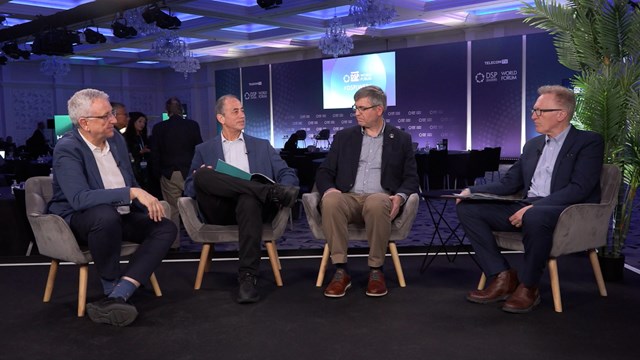
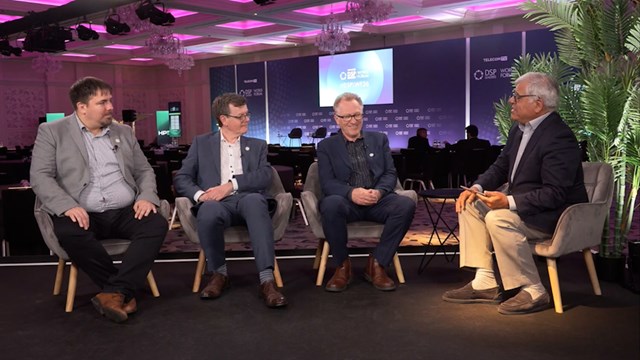
Here I am, Tony Poulos at DSP Leaders World Forum in Windsor. We've got another session of the extra shot. We've been talking just now all about the automotive industry and all about connected cars and how the two fit together. With me today, I have three fabulous people to interview. Firstly, Maxime Flament, who is the CTO of 5GAA. Welcome, Maxime. Next to him, Professor Colin Lee, a familiar face to a lot of us, who's the principal product owner of VCDB Strategy and a technical specialist for V2X at the digital product platform of Jaguar Land Rover. You have a very long title, which means you're a very important person, Colin. And also we have Patrick Jeanbart, who is the head of connected cars at Orange Business. Gentlemen, thank you for being with me. Colin, I'm going to start with you. Please tell us exactly what is a connected car.
Prof. Colin Lee, Jaguar Land Rover (01:10):
Right. Connected car in terms of what we call V2X or C-V2X, we often hear that term. Effectively, what we're trying to do is mimic the human body. So if you imagine if you're an autonomous car, you're autonomous, you can walk anywhere you like, open doors and go up and down the stairs. You've got sensors, you've got your eyes, you can't see through a wall, but you can see that you can feel the heat, you can feel your weight. So effectively, if you take a car, it can do all those things. Well, at least if it's autonomous, it can do those things. Now, what V2X does in terms of the connected car, you start hearing through your ears, you can start hearing what's behind you. You can start hearing what's through the walls. And next thing you know, you start getting a better idea of the environment.
(01:54):
So you can set yourself up a heat map of what's around you. You can say, we can hear that noise in the background. We know the people there. So in a way, we're trying to add ears to the vehicle that can see beyond the horizon.
Tony Poulos, TelecomTV (02:07):
Maxime, the 5GAA is obviously an organisation that's communicating with a lot of players in this area. What exactly does it do and what is the role it's playing in the industry?
Maxime Flament, 5GAA (02:16):
Yeah. So 5G Automotive Association is basically putting the telco industry together with the automotive industry. It's making sure that they meet, they understand each other, they talk the same language. And at the end of the day that the requirements or the demands or the wishes of the vehicle manufacturers as a vertical, we call it vertical in the 5G world. These wishes are being delivered by the mobile network operators.
Tony Poulos, TelecomTV (02:47):
Patrick, what sort of data is being collected from a connected car? Where's it going to?
Patrick Jeanbart, Orange Business (02:53):
There are a lot of data that are collected from the different sensors as Colin explained from the vehicle, but also now more and more from the users and the passengers and the drivers that are inside the vehicle that are talking, for example, and you have mics into the vehicle. So now we can talk about targeted advertising or stuff like that. So there are a lot of data that are collected. All the data are going through the network of the different connectivity service providers or telcos and all the data are going to the backend of the car manufacturers. That's something that is mandatory. All the data are going here because it's a way for us and for them and for us also to secure the data and also the way to monetise the data and to sell the data to different kind of third parties.
Tony Poulos, TelecomTV (03:48):
Well, I'm going to get to that in a moment. Colin, how is it connected? How is the car connected to the manufacturer? Is there a telephone in there? What's the device that works?
Prof. Colin Lee, Jaguar Land Rover (03:57):
So you may have seen the shark fins on the vehicles. So we've got various, that's basically an antenna cluster and we have effectively a multiplexer of different types of inputs. So we have, for example, cellular, WiFi, Bluetooth. There may be others in the future. That comes into a single pipe and then basically the car now has connectivity to the outside world. Now connected to the other side of that, like you were just saying earlier, there's kind of like a mini, mini controlled area that is looking at the car, which the car will only listen to that area, that one port. It won't listen to anything else. And the idea being is that we can now make sure we do our connectivity to the vehicle through that, which is inside each of the OEMs have their own equivalent to the same thing.
Tony Poulos, TelecomTV (04:46):
And Maxime, when a car is being sent to another country, is it set up differently for each of those countries? Are there different requirements?
Maxime Flament, 5GAA (04:55):
Well, we wish that it would be the same everywhere. Practically, this is very difficult to realise. And we end up with different profiles or different solutions that we have to manage when a car goes from one country to the country. But what every car has in common is that they are permanently roaming. That means that they are never home. There is no place where it's home. And so they are always in a situation where they are seen by the local mobile network operators as foreigners.
Tony Poulos, TelecomTV (05:34):
So the car is a customer of Orange, for example. Who's paying for that service to be that information and connectivity to be followed through? Is it the car manufacturer?
Patrick Jeanbart, Orange Business (05:44):
The car manufacturer is paying, for example, Orange because Orange Business is enabling ... There is a difference between Orange Business and Orange France. Right. Okay. So Orange Business is a customer of Orange France. We are using the roaming agreements of Orange France in order to enable our customer in France, for example, to home on Orange on SFR on Bouygues and on Free. It's the same we are also providing in Germany and our homing agreements enables the car manufacturer to home on the different local MNOs. Why are they doing that? It's historically it's because in order to have somehow a quality of service and to have a coverage across the country, it's good to use the different networks of the different telcos that are in an area. That's all.
Tony Poulos, TelecomTV (06:33):
Colin, you talked about in the conversation a little earlier about how heavily cars are regulated or connected. I didn't understand. Who regulates you and what is that regulation?
Prof. Colin Lee, Jaguar Land Rover (06:44):
So the regulations come from EU Commission, the various governments around the world and they vary quite a bit. So a China government will have a completely different, possibly potentially a slightly different way of looking at it. So for example, California, you have to be open with the data. Other areas, you're not allowed to share data. Germany won't allow you to track anybody. There's a load of different ones around the world. So we have to make sure that every car ... So bear in mind, we build a car. We don't have to build it for that country, make sure it's meeting the regulation of that country and so on. So it is quite difficult.
Tony Poulos, TelecomTV (07:19):
And what partners are involved in this connectivity exercise? It can't just be the car manufacturer and the telco. What are the other players? 5GAA obviously is involved with doing some of the standardisation.
Prof. Colin Lee, Jaguar Land Rover (07:32):
Who's that to?
Tony Poulos, TelecomTV (07:32):
Well, either one of them.
Prof. Colin Lee, Jaguar Land Rover (07:34):
Well, I mean, from a car perspective, we have lots of different people we speak to depending on where you are in the world. If we can have people that can do multiple things for us to save us time and energy, then we would exploit that as much as we can as part of a business deal, for example. But like at home, ideally you'd want one internet connection that does everything.
Patrick Jeanbart, Orange Business (07:57):
Yes.
Prof. Colin Lee, Jaguar Land Rover (07:57):
I mean, we don't know who we connect to, but it just does it, but we don't have that, do we? And the reason why we don't have that is because there are so many holes in lots of things we do. If you take just Bluetooth and it goes as far as a certain distance. If you go to WiFi only as far as a certain distance, but it's a lot faster, then you've got cellular. Most of the time it's fine, but until Jaguar Land Rover cars go in the middle of the desert, for example, what do we do there?
Tony Poulos, TelecomTV (08:21):
Yeah. What are the other partners that are involved?
Maxime Flament, 5GAA (08:23):
Yeah. So when we look at the connected vehicle ecosystem, we have obviously the vehicle manufacturers. They are tier suppliers, tier one suppliers and so on. On the side of the telcos, we have the mobile network operators, but under that we have all the equipment suppliers, network equipment suppliers. And then a whole set of facilitators or IT solution vendors, chip vendors and testing equipment vendors. So the ecosystem is pretty broad and to make connected vehicles a reality.
Patrick Jeanbart, Orange Business (09:03):
And in fact, and what I like to say is that Orange Business, we are more a digital partner is to be able to integrate different kind of connectivity solution or mainly the cellular connectivity, but also now more and more the satellite connectivity. If you are in the middle of the desert, of course you will need satellite connectivity because there is no cellular connectivity. If you are cross-boarding also, for example, it's a solution for us cross-boarding to use the satellite connectivity in order not to lose the connectivity. So here is how we will be able to aggregate the different solutions from different third parties in order to sustain the connectivity and the digital services.
Tony Poulos, TelecomTV (09:45):
And it came up in the presentations. My last question, how critical is that 100% connectivity and is it possible?
Prof. Colin Lee, Jaguar Land Rover (09:52):
100% critical, honestly. Basically, to you, you wouldn't understand what I'm saying. So the car wouldn't be able to do the same. It's like having a dodgy mic. So what you end up with is that you're trying to communicate to the car, you're trying to find out perhaps what's wrong on a diagnostic problems and you can't do anything with it. Besides that, the customer is expecting it to be 100% connected. I mean, how many times have you used your phone without being rude to any kind of MNO and you find that it's probably having a problem changing, but you've got to remember, cars go to places where you've got less per thousand circa. So therefore, if you do go in the middle of desert, you still expect it to work. So forgive that way I was speaking there, but I was trying to pretend I was a dodgy mic.
Tony Poulos, TelecomTV (10:39):
We've reached our 10 minutes actually, so you probably answered it for everybody. Gentlemen, thank you so much for being with me today. And now I'm going to be very careful when I lose patience with other drivers in case somebody's listening to me. Thank you very much for being with me. Thank you, Colin and Maxime. Thank you.
Maxime Flament, 5GAA (10:55):
Thank you.
Please note that video transcripts are provided for reference only – content may vary from the published video or contain inaccuracies.
Extra Shot with Tony Poulos
Three industry experts examine the practical challenges of digital sovereignty, from controlling data movement to managing supply chain diversity. The discussion covers whether true data sovereignty is achievable, the costs enterprises will pay for certainty, and how telecoms operators can partner with hyperscalers. The conversation also addresses AI's impact on network infrastructure, exploring whether current networks can handle AI traffic demands and how quality of service requirements may challenge net neutrality principles.
Broadcast live 19 May 2026
Featuring:

Maxime Flament
CTO, 5GAA

Prof. Colin Lee
Principal Product Owner VCDP Strategy and Technical Specialist V2X, Digital Product Platform, Jaguar Land Rover (JLR)

Patrick Jeanbart
Head of Connected Cars, Orange Business