Building resilient networks with AI-powered intelligent core technology

By James Pearce
Jun 18, 2026
To embed our video on your website copy and paste the code below:
<iframe src="https://www.youtube.com/embed/jBA_k5LTolU?modestbranding=1&rel=0" width="970" height="546" frameborder="0" scrolling="auto" allowfullscreen></iframe>
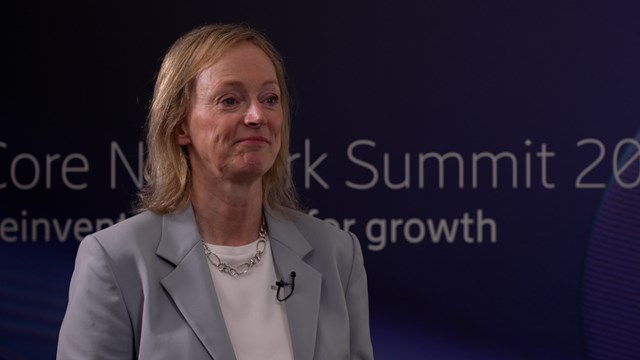
I'm delighted to be joined today by Monica Zethzon, who is Head of Solution at Area Core Networks at Ericsson. Thank you so much for joining us, Monica. Let's dive in. The theme of the event obviously is reinventing business for growth, but what are the main growth opportunities that you're seeing for CSPs?
Monica Zethzon, Ericsson (00:22):
You know what, I actually see a lot of growth opportunities and I think that's so rewarding with this event, that it's not like one or two service providers demonstrating what they can do for growth, but it's actually starting to spread, and globally as well. The main theme I would say that's coming across at the event is really differentiated connectivity. It's been talked about for a while. 5G SA brings the capabilities, but maybe not leveraged to the full extent. But here we see now, more and more customers really see that there are moments in, I would say, in enterprises and consumers' lives, when you really are keen to pay extra for that guaranteed and prioritized connectivity. And that I think is actually the most straightforward opportunity that we see. With that said, I would say on the horizon we see there's a lot of discussions about physical AI, right? And how can the service provider play a role also in physical AI?
(01:14):
And with that, we also see that starting with the differentiated connectivity already today without physical AI is really laying a good foundation even for when there is an opportunity for physical AI. I think that was probably the main theme that came across. I see others that are maybe also a bit, related, like AI and voice. I mean, voice has been a standard service for a long time. Now, suddenly, there are great opportunities also for service providers to do things device-independent, like voice translation-type services. Location has also become a great opportunity. And actually also not to forget about mission-critical networks. We also hear a lot of interest for, primarily, I would say, public safety being an opportunity for service providers where, again, like the capabilities of the 5G SA networks are starting to be truly leveraged. So a lot actually of growth opportunities for service providers.
James Pearce, TelecomTV (02:11):
I think that's really, really interesting. But in terms of practical steps for the CSP, what are the first steps that you would recommend they take to capture these opportunities? I mean, what should they be doing to monetise new services?
Monica Zethzon, Ericsson (02:25):
Look, I think it's an easy trap to think that it's some technology things that they need to fix. I think we're good at that. I would say that the one thing is get close to your product and marketing people within the service providers. It's also feedback, I think. I'm hearing some of the people joining here, at the event, reflecting, "Ah, we should have brought our marketing people." Because unless you know how to actually make this accessible for both enterprises or consumers, like that whole customer journey, the ease of understanding the service, the ease of onboarding, I think that is the element that tends to get a bit lost when we focus too much of getting the networks ready. So that would probably be my number-one thing, to be honest.
James Pearce, TelecomTV (03:06):
Interesting, so it's about a whole holistic approach to it. Looking beyond growth, what else is top of mind when you speak to customers?
Monica Zethzon, Ericsson (03:15):
I would say that's network resiliency. I think the networks are becoming such critical infrastructure for society. And you know, I talked about mission-critical networks being one such thing. So how do we ensure that these networks are always up? And from that perspective, it's also clearly linked to, I would say automation. Because human errors tend to, or human tends to, make errors. How can you get that out of the equation? So looking at ways to improve the resiliency and leveraging very much through an increased automation of how we operate the networks.
James Pearce, TelecomTV (03:51):
Well automation kind of leads us nicely onto AI, which is a hot topic right now. In your keynote you mentioned Ericsson Intelligent Core. Can you tell us a bit about this and what benefits it brings for your customers?
Monica Zethzon, Ericsson (04:03):
Yeah, so the core we have today is also intelligent, but I would say maybe not fuelled by AI. So the Ericsson Intelligent Core is really what we already have as a foundation of really solid, resiliency mechanisms. What if we fuel this also with AI capabilities? And then, I think this comes then with different layers of how we are injecting an AI into this. You will have agents within the network functions themselves. So any kind of insights, you would have within the separate network function and wherever you're able to take a decision based on an intent for single network function, we will do so. But sometimes you also, in order to take the right decisions, talking again about resiliency, you would want to make sure that you can prevent a fault from happening, because you see some anomaly in the network. What action do you need to take? That would be very difficult to see from within a single network function.
(04:57):
Then we will make sure we expose the data to the right level, which in our case we're leveraging the Ericsson Intelligent Automation platform where we basically can consolidate data from multiple sources, take the relevant decision and then trigger the right type of actions back into the network functions. So I would say the Ericsson Intelligent Core works at different levels - both the network functions themselves but also at the higher level with bigger business intents. And the primary driver from my side, where we want to see this now is on this network resiliency because I believe this is another way for us to make that come alive at the next level.
James Pearce, TelecomTV (05:43):
So you also mentioned zero-outage networks, which seems very ambitious to me. How do we get there and what is Ericsson doing to make it a real thing?
Monica Zethzon, Ericsson (05:51):
It sounds ambitious, but I actually think it's perfectly doable. For me, it comes back to the fact that the networks are becoming very complex, right? And complexity and humans is not necessarily a good combination. Simply, it becomes error-prone in that respect. So I think what we're trying to do is remove as much as possible - the reliance on humans having control of everything. And then with that, also here we see that the Ericsson Intelligent Core or the use of AI will definitely be a source of help. Initially, of course, there will be have to be a lot of human oversight in order to see or to really make the decisions, but to get aided by the insights you can get out of the network to make sure you make these right decisions. So I think we're building on a foundation with strong resilience and mechanisms in the network functions.
(06:42):
We have already today a lot of activity when it comes to how can we do upgrades of the networks autonomously in service software upgrades, getting out security vulnerabilities by having these frequent software upgrades. And then if you put AI and Ericsson Intelligent Core on top of that, with the next level of automation, I think you have a chain of capabilities that truly actually make this a reality. And these are the things we from Ericsson's side and are investing in in order to make sure that we are actually driving towards that clear objective of zero network outages.
James Pearce, TelecomTV (07:15):
I'm excited to see it come to fruition. Thank you so much for joining us.
Monica Zethzon, Ericsson (07:18):
Thank you.
Please note that video transcripts are provided for reference only – content may vary from the published video or contain inaccuracies.
Monica Zethzon, Head of Solution Area Core Networks, Ericsson
Monika Zethzon, head of solution area core networks at Ericsson, outlines key growth opportunities for CSPs, emphasising differentiated connectivity as enterprises and consumers show a willingness to pay for guaranteed, prioritised services. She discusses emerging areas, including physical AI, voice translation services, and mission-critical networks for public safety, and explains how the Ericsson Intelligent Core solution integrates AI across network functions to improve network resiliency and achieve zero outage networks.
Recorded May 2026
Related Resources
Email Newsletters
Sign up to receive TelecomTV's top news and videos, plus exclusive subscriber-only content direct to your inbox.