To embed our video on your website copy and paste the code below:
<iframe src="https://www.youtube.com/embed/y4mNMVj-7GU?modestbranding=1&rel=0" width="970" height="546" frameborder="0" scrolling="auto" allowfullscreen></iframe>
James Pearce, TelecomTV (00:05):
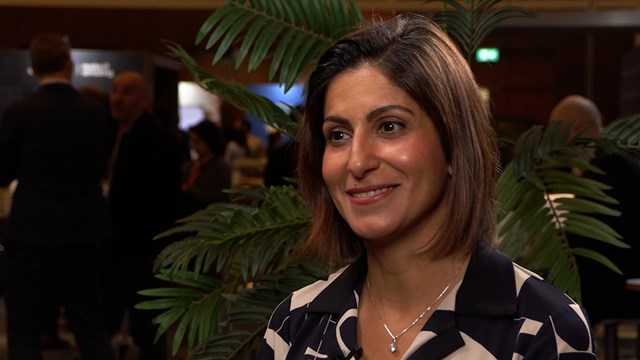
Welcome to TelecomTV. I'm James Pearce and I'm at FutureNet World in London. I'm delighted to be joined today by Dr Mariam Kaynia, who is the Chief Data and Information Officer at Eutelsat. Welcome, Mariam. Why don't you start by giving us an introduction to yourself and what you do at Eutelsat?
Dr Mariam Kaynia, Eutelsat (00:23):
Sure, happy to. I am leading the data, AI and IT strategy and execution at Eutelsat, which involves delivering new functionalities and services for our customers. It involves data platform management, cybersecurity, and obviously also AI governance. I come from a telecom background — I was at Telefonica before, and prior to that I was at McKinsey, and prior to that I did a PhD in wireless communications. So I've been in the telco world for a long time, but I have always worn different hats — starting with academia, then going to business, then going to the operator side, and I did many different roles there, before landing now in the satellite market and bringing some of the telecom knowledge in.
James Pearce, TelecomTV (01:12):
Now let's look at your role a little bit more, because you mentioned AI. Tell me about how Eutelsat is using AI in its operations at the moment, and what kind of outcomes and results are you seeing?
Dr Mariam Kaynia, Eutelsat (01:24):
We've been using AI for a long time. I mean, again, for most in this industry it's nothing new. However, what is changing is the mass-market driven aspect of it. It's coming with gen AI and also generative AI and agentic AI, which really brings it to the next level. The way we are managing or adopting it is by looking at it through three different pillars, if you want. One is AI that is mass-market driven — tools that are off-the-shelf, available, like the Copilots of the world — where we focus more on training and governance to make sure that it is used responsibly, and that we have the right guardrails and the right security in place. Then we have — let me call it maybe the other extreme — which is the more advanced machine learning algorithms, the more traditional AI.
(02:16):
We've always done that. And here we are starting to strengthen the governance to make sure that we do more value-based prioritisation and selection of use cases and capture the value from them. And then there is this middle pillar, which is more new, where you have AI in the hands of many — not in the hands of a few, and not in the hands of all, but really in the hands of the many. And it is all about creativity in finding out where you can bring generative AI and agentic AI to life. Here we are working with all the functions. Let me give a couple of examples. We are working with our operations teams where we are taking all of the data from level one, level two, level three. We are looking at incidents and categorising them. Previously this was done by a human, and now we have a digital agent that categorises the different incidents.
(03:08):
And then we have another agent that actually looks at the root cause, defines the root cause, finds a solution to it, and even feeds that back in order to map it to the right teams to do the fixes. This is just on the operations side. On the engineering and connectivity side, as you can imagine, satellites are hard. You send a satellite up in the air — you can't send the field force up in the air tomorrow if you have a problem. So we have a lot of anomaly detection, fault detection, preventive maintenance that needs to be built in. We have weather forecasting and adapting to different dynamic weather situations. We have power management — again, once you're up there, you have a certain amount of fuel, so how do you make sure to optimise how much power to send when, depending on the weather and the location?
(03:58):
So there is a lot of satellite-specific AI that we also do. And last but not least, as mentioned, is the part that is a bit harder to monitor in terms of value, but it's about getting the everyday usage of it — the Copilot, the Rovo of the world, the Snowflake Cortex. So we are really getting the training out there for people to use it and make sure that they optimise their daily jobs.
James Pearce, TelecomTV (04:24):
Okay. So you've given some really good examples there. Let's hone in on agentic AI. Do you think it's mature enough at the moment to be used in day-to-day operations for critical infrastructure such as your satellites or the wider telecoms industry?
Dr Mariam Kaynia, Eutelsat (04:37):
Yes, I believe so. As a technology, as an AI algorithm, I believe it is mature enough. But like any new technology, and especially any disruptive technology, it's really important to govern it right and do it correctly. And doing it correctly means, first of all, having the right guardrails in terms of security — how you are avoiding AI hallucinations, how do you train the model, how do you manage the ecosystem around it — which is really important to establish. The second piece, and probably the most important, is the data that you feed it. Your data needs to be clean. You need to make sure you do the right context engineering so that when you ask for the right data field or the right metric, it understands exactly what data points it goes back to. This is sometimes forgotten — people think that you just plug it in and it extracts the answer and you're done.
(05:30):
You need to train it. Just to give an example — if someone asks tomorrow, "What's the throughput?" — just to define what that throughput is: is it the five-minute value? Is it the one-hour average? How do you map that into your data and make sure there is only one field being fed back? So that type of data cleanliness and data enrichment is super important. And last but not least is also the governance in terms of value afterwards, because at the end you need to make sure that the user and the use case owner own the results and can verify and validate that it is actually correct — so that you can either go back and retrain the model and fix it, or you're able to actually use it and it is adopted by the one who actually needs it.
James Pearce, TelecomTV (06:20):
Given your role, what is it that you need from the technology and developer communities and the ecosystem to help you achieve your goals at Eutelsat?
Dr Mariam Kaynia, Eutelsat (06:30):
We need partnerships. I am a fundamental believer in hyper-collaboration. The technology landscape and generally the world is getting more and more complex, and we need more partners to work together in order to disrupt and build new solutions, new technologies, and to evolve. So what I need from our partners is really the skin in the game in order to achieve the outcomes. It's no longer about "here's my technology, here's my tool, I can do it great, I'm better than someone else." It's much more about understanding the customer's problem statement, committing to an outcome, and really in a true partnership way going and trying to solve it — finding the answer together.
James Pearce, TelecomTV (07:12):
We're obviously seeing a bit of a resurgence in the satellite industry. It's been top news this year — it's been such an interesting time, after maybe a few years where it wasn't the headline news. What do you think is driving that, and what opportunity does that present for an incumbent like Eutelsat, who have been doing this for such a long time?
Dr Mariam Kaynia, Eutelsat (07:29):
Indeed, the satellite market is growing extensively. It's a technology that has in a way always been there, but in a different format. It's the first time that satellite technology is coming closer to telecom-type services. And this is, to be very honest, thanks to Starlink, which made it mass-market driven. With that, you can do so much more. And you've probably seen the research — there is an explosion in terms of the market. What it does is, first of all, it allows you to get connectivity in areas that you can't reach easily. Second, it gives you low latency and high resilience. So many of our customers want to have a failover or some kind of redundancy in order to cover situations where you might have problems with your landline. Thirdly, it covers areas that you just cannot reach with terrestrial networks — ships in the ocean, airlines — it has always been very expensive and very tough to cover those from the telecom operator side.
(08:32):
So the surge of telecom-oriented satellite services is definitely there. It's growing extensively, there's a lot of value there. And last but not least, I don't want to forget the governmental services. Again, the geopolitics of the world is strengthening this need more and more. You need European sovereign solutions, and we need to be able to bring that — I mean, this technology, even though we are a global player, at the end we operate as a European player, and there are many services we can bring with that.
James Pearce, TelecomTV (09:04):
That sounds like a really exciting time for the industry. Mariam, thank you so much for joining us on TelecomTV.
Dr Mariam Kaynia, Eutelsat (09:09):
Thank you for having me.
Welcome to TelecomTV. I'm James Pearce and I'm at FutureNet World in London. I'm delighted to be joined today by Dr Mariam Kaynia, who is the Chief Data and Information Officer at Eutelsat. Welcome, Mariam. Why don't you start by giving us an introduction to yourself and what you do at Eutelsat?
Dr Mariam Kaynia, Eutelsat (00:23):
Sure, happy to. I am leading the data, AI and IT strategy and execution at Eutelsat, which involves delivering new functionalities and services for our customers. It involves data platform management, cybersecurity, and obviously also AI governance. I come from a telecom background — I was at Telefonica before, and prior to that I was at McKinsey, and prior to that I did a PhD in wireless communications. So I've been in the telco world for a long time, but I have always worn different hats — starting with academia, then going to business, then going to the operator side, and I did many different roles there, before landing now in the satellite market and bringing some of the telecom knowledge in.
James Pearce, TelecomTV (01:12):
Now let's look at your role a little bit more, because you mentioned AI. Tell me about how Eutelsat is using AI in its operations at the moment, and what kind of outcomes and results are you seeing?
Dr Mariam Kaynia, Eutelsat (01:24):
We've been using AI for a long time. I mean, again, for most in this industry it's nothing new. However, what is changing is the mass-market driven aspect of it. It's coming with gen AI and also generative AI and agentic AI, which really brings it to the next level. The way we are managing or adopting it is by looking at it through three different pillars, if you want. One is AI that is mass-market driven — tools that are off-the-shelf, available, like the Copilots of the world — where we focus more on training and governance to make sure that it is used responsibly, and that we have the right guardrails and the right security in place. Then we have — let me call it maybe the other extreme — which is the more advanced machine learning algorithms, the more traditional AI.
(02:16):
We've always done that. And here we are starting to strengthen the governance to make sure that we do more value-based prioritisation and selection of use cases and capture the value from them. And then there is this middle pillar, which is more new, where you have AI in the hands of many — not in the hands of a few, and not in the hands of all, but really in the hands of the many. And it is all about creativity in finding out where you can bring generative AI and agentic AI to life. Here we are working with all the functions. Let me give a couple of examples. We are working with our operations teams where we are taking all of the data from level one, level two, level three. We are looking at incidents and categorising them. Previously this was done by a human, and now we have a digital agent that categorises the different incidents.
(03:08):
And then we have another agent that actually looks at the root cause, defines the root cause, finds a solution to it, and even feeds that back in order to map it to the right teams to do the fixes. This is just on the operations side. On the engineering and connectivity side, as you can imagine, satellites are hard. You send a satellite up in the air — you can't send the field force up in the air tomorrow if you have a problem. So we have a lot of anomaly detection, fault detection, preventive maintenance that needs to be built in. We have weather forecasting and adapting to different dynamic weather situations. We have power management — again, once you're up there, you have a certain amount of fuel, so how do you make sure to optimise how much power to send when, depending on the weather and the location?
(03:58):
So there is a lot of satellite-specific AI that we also do. And last but not least, as mentioned, is the part that is a bit harder to monitor in terms of value, but it's about getting the everyday usage of it — the Copilot, the Rovo of the world, the Snowflake Cortex. So we are really getting the training out there for people to use it and make sure that they optimise their daily jobs.
James Pearce, TelecomTV (04:24):
Okay. So you've given some really good examples there. Let's hone in on agentic AI. Do you think it's mature enough at the moment to be used in day-to-day operations for critical infrastructure such as your satellites or the wider telecoms industry?
Dr Mariam Kaynia, Eutelsat (04:37):
Yes, I believe so. As a technology, as an AI algorithm, I believe it is mature enough. But like any new technology, and especially any disruptive technology, it's really important to govern it right and do it correctly. And doing it correctly means, first of all, having the right guardrails in terms of security — how you are avoiding AI hallucinations, how do you train the model, how do you manage the ecosystem around it — which is really important to establish. The second piece, and probably the most important, is the data that you feed it. Your data needs to be clean. You need to make sure you do the right context engineering so that when you ask for the right data field or the right metric, it understands exactly what data points it goes back to. This is sometimes forgotten — people think that you just plug it in and it extracts the answer and you're done.
(05:30):
You need to train it. Just to give an example — if someone asks tomorrow, "What's the throughput?" — just to define what that throughput is: is it the five-minute value? Is it the one-hour average? How do you map that into your data and make sure there is only one field being fed back? So that type of data cleanliness and data enrichment is super important. And last but not least is also the governance in terms of value afterwards, because at the end you need to make sure that the user and the use case owner own the results and can verify and validate that it is actually correct — so that you can either go back and retrain the model and fix it, or you're able to actually use it and it is adopted by the one who actually needs it.
James Pearce, TelecomTV (06:20):
Given your role, what is it that you need from the technology and developer communities and the ecosystem to help you achieve your goals at Eutelsat?
Dr Mariam Kaynia, Eutelsat (06:30):
We need partnerships. I am a fundamental believer in hyper-collaboration. The technology landscape and generally the world is getting more and more complex, and we need more partners to work together in order to disrupt and build new solutions, new technologies, and to evolve. So what I need from our partners is really the skin in the game in order to achieve the outcomes. It's no longer about "here's my technology, here's my tool, I can do it great, I'm better than someone else." It's much more about understanding the customer's problem statement, committing to an outcome, and really in a true partnership way going and trying to solve it — finding the answer together.
James Pearce, TelecomTV (07:12):
We're obviously seeing a bit of a resurgence in the satellite industry. It's been top news this year — it's been such an interesting time, after maybe a few years where it wasn't the headline news. What do you think is driving that, and what opportunity does that present for an incumbent like Eutelsat, who have been doing this for such a long time?
Dr Mariam Kaynia, Eutelsat (07:29):
Indeed, the satellite market is growing extensively. It's a technology that has in a way always been there, but in a different format. It's the first time that satellite technology is coming closer to telecom-type services. And this is, to be very honest, thanks to Starlink, which made it mass-market driven. With that, you can do so much more. And you've probably seen the research — there is an explosion in terms of the market. What it does is, first of all, it allows you to get connectivity in areas that you can't reach easily. Second, it gives you low latency and high resilience. So many of our customers want to have a failover or some kind of redundancy in order to cover situations where you might have problems with your landline. Thirdly, it covers areas that you just cannot reach with terrestrial networks — ships in the ocean, airlines — it has always been very expensive and very tough to cover those from the telecom operator side.
(08:32):
So the surge of telecom-oriented satellite services is definitely there. It's growing extensively, there's a lot of value there. And last but not least, I don't want to forget the governmental services. Again, the geopolitics of the world is strengthening this need more and more. You need European sovereign solutions, and we need to be able to bring that — I mean, this technology, even though we are a global player, at the end we operate as a European player, and there are many services we can bring with that.
James Pearce, TelecomTV (09:04):
That sounds like a really exciting time for the industry. Mariam, thank you so much for joining us on TelecomTV.
Dr Mariam Kaynia, Eutelsat (09:09):
Thank you for having me.
Please note that video transcripts are provided for reference only – content may vary from the published video or contain inaccuracies.
Dr Mariam Kaynia, Chief Data & Information Officer, Eutelsat
Dr Mariam Kaynia, chief data and information officer at Eutelsat, describes how the satellite operator is putting AI to work across the company, discusses the potential of agentic AI and the importance of data enrichment, and explains why industry collaboration is critical.
Recorded April 2026
Email Newsletters
Sign up to receive TelecomTV's top news and videos, plus exclusive subscriber-only content direct to your inbox.